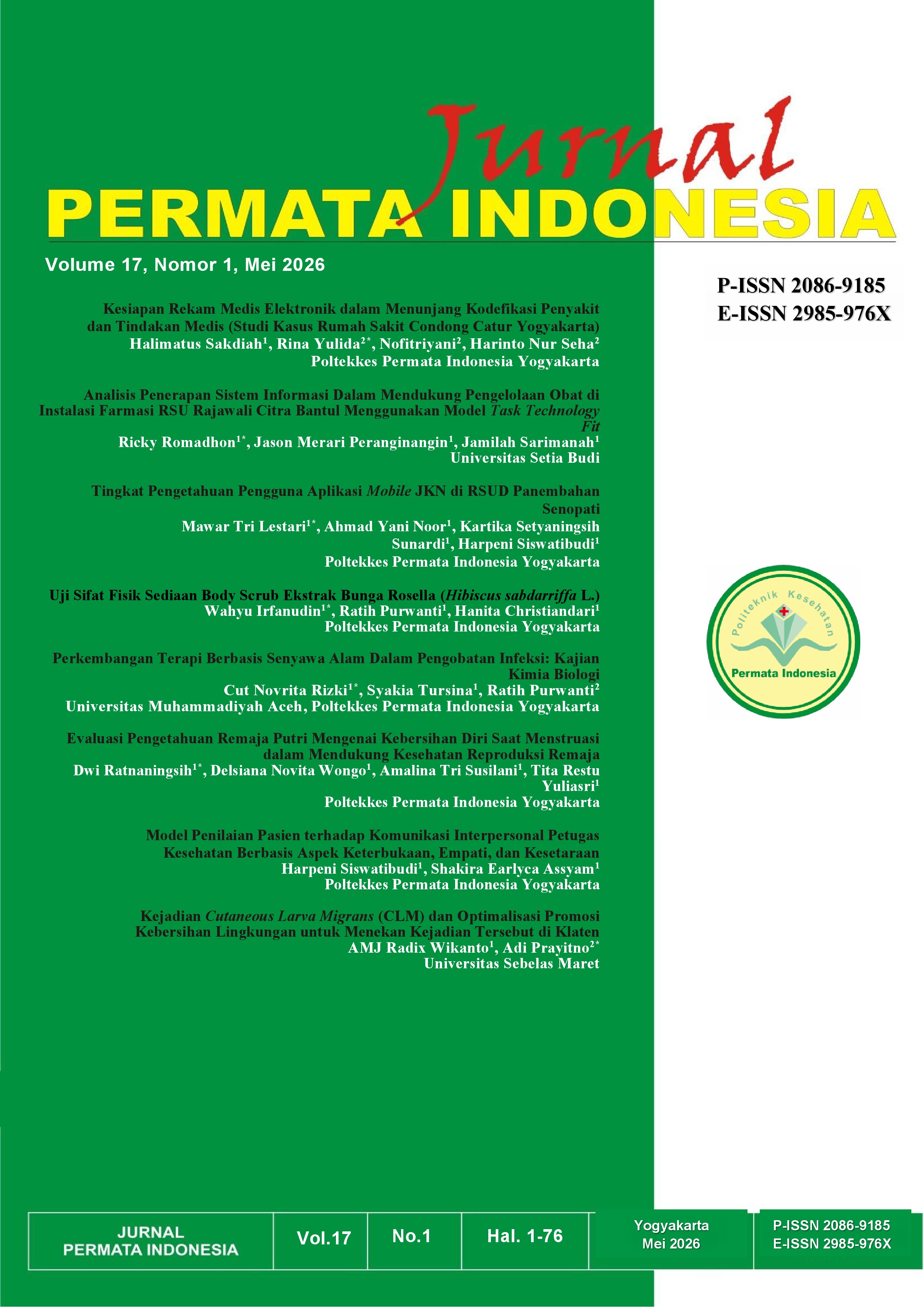
Perkembangan Terapi Berbasis Senyawa Alam Dalam Pengobatan Infeksi: Kajian Kimia Biologi
DOI:
https://doi.org/10.59737/jpi.v17i1.400Keywords:
senyawa alam, antimikroba, resistensi antibiotic, kimia biologi, terapi infeksiAbstract
Penyakit infeksi masih menjadi salah satu penyebab utama morbiditas dan mortalitas di dunia. Peningkatan resistensi mikroorganisme terhadap antibiotik konvensional mendorong pengembangan terapi alternatif berbasis senyawa alam. Artikel ini bertujuan mengkaji perkembangan terapi berbasis senyawa alam dalam pengobatan infeksi dari perspektif kimia biologi. Metode yang digunakan berupa studi literatur terhadap artikel ilmiah dan buku terbitan tahun 2018–2025. Hasil kajian menunjukkan bahwa senyawa bioaktif seperti flavonoid, alkaloid, terpenoid, fenolik, minyak atsiri, dan peptida antimikroba memiliki aktivitas antimikroba melalui berbagai mekanisme, antara lain kerusakan membran sel mikroba, penghambatan sintesis protein, inhibisi pembentukan biofilm, serta modulasi quorum sensing. Perkembangan teknologi nanoenkapsulasi dan kombinasi senyawa alam dengan antibiotik modern turut meningkatkan efektivitas terapi dan menurunkan resistensi mikroba. Berdasarkan kajian kimia biologi, hubungan antara struktur kimia dan aktivitas biologis senyawa alam menjadi dasar penting dalam pengembangan kandidat obat antimikroba masa depan. Dengan demikian, terapi berbasis senyawa alam memiliki prospek besar sebagai alternatif pengobatan infeksi yang lebih aman dan efektif.
References
Álvarez-Martínez, F., Barrajón-Catalán, E., & Micol, V. (2020). Tackling antibiotic resistance with compounds of natural origin: A comprehensive review. Biomedicines, 8(10), 405. https://doi.org/10.3390/biomedicines8100405
González-Pastor, R., Carrera-Pacheco, S. E., Zúñiga-Miranda, J., Rodríguez-Pólit, C., Mayorga-Ramos, A., Guamán, L. P., & Barba-Ostria, C. (2023). Current landscape of methods to evaluate antimicrobial activity of natural extracts. Molecules, 28(4), 1995. https://doi.org/10.3390/molecules28041995
Guglielmi, P., Pontecorvi, V., & Rotondi, G. (2020). Natural compounds and extracts as novel antimicrobial agents. Expert Opinion on Therapeutic Patents, 30(12), 949–962. https://doi.org/10.1080/13543776.2020.1813714
Kalalo, M. J., Wewengkang, D. S., & Rotinsulu, H. (2020). Potensi antimikroba cengkeh (Syzygium aromaticum): Tinjauan literatur. Pharmacy Medical Journal, 3(2), 1–8.
Lobiuc, A., Pavăl, N. E., Mangalagiu, I., Gheorghita, R., Teliban, G., Amăriucăi-Mantu, D., & Stoleru, V. (2023). Future antimicrobials: Natural and functionalized phenolics. Molecules, 28(3), 1112. https://doi.org/10.3390/molecules28031112
Pacyga, K., Pacyga, P., Topola, E., Viscardi, S., & Duda-Madej, A. (2024). Bioactive compounds from plant origin as natural antimicrobial agents for the treatment of wound infections. International Journal of Molecular Sciences, 25(2), 1154. https://doi.org/10.3390/ijms25021154
Qadri, H., Shah, A. H., Andrabi, S. M., Alshehri, B., Almilaibary, A., & Mir, M. A. (2022). Natural products and their semi-synthetic derivatives against antimicrobial-resistant human pathogenic bacteria and fungi. Saudi Journal of Biological Sciences, 29(5), 1009–1022. https://doi.org/10.1016/j.sjbs.2021.11.034
Saha, P., Rahman, F., Hussain, F., Rahman, S., & Rahman, M. M. (2022). Antimicrobial diterpenes: Recent development from natural sources. Frontiers in Pharmacology, 12, 823624. https://doi.org/10.3389/fphar.2021.823624
Sari, R., Nurhidayati, N., & Fitriani, D. (2024). Potential of Indonesian plants as polymicrobial anti-biofilm agents. Borneo Journal of Pharmacy, 7(1), 12–25.
Stan, D., Enciu, A., Mateescu, A., Ion, A., Brezeanu, A. C., Stan, D., & Tănase, C. (2021). Natural compounds with antimicrobial and antiviral effect and nanocarriers used for their transportation. Frontiers in Pharmacology, 12, 723233. https://doi.org/10.3389/fphar.2021.723233
Vaou, N., Stavropoulou, E., Voidarou, C., Tsakris, Z., Rozos, G., Tsigalou, C., & Bezirtzoglou, E. (2022). Interactions between medical plant-derived bioactive compounds: Focus on antimicrobial combination effects. Antibiotics, 11(8), 1014. https://doi.org/10.3390/antibiotics11081014
Woo, S., Kim, Y., & Lee, J. (2023). Recent advances in the discovery of plant-derived antimicrobial natural products to combat antimicrobial resistant pathogens. Natural Product Reports, 40(7), 1271–1290. https://doi.org/10.1039/D2NP00074K
Zhang, Q., Yan, Z., Meng, Y., Hong, X., Shao, G., Ma, J., Cheng, X., Liu, J., Kang, J., & Fu, C. (2021). Antimicrobial peptides: Mechanism of action, activity and clinical potential. Military Medical Research, 8(1), 48. https://doi.org/10.1186/s40779-021-00343-2
Downloads
Published
How to Cite
Issue
Section
License
Copyright (c) 2026 Cut Novrita Rizki, Syakia Tursina, Ratih Purwanti

This work is licensed under a Creative Commons Attribution 4.0 International License.